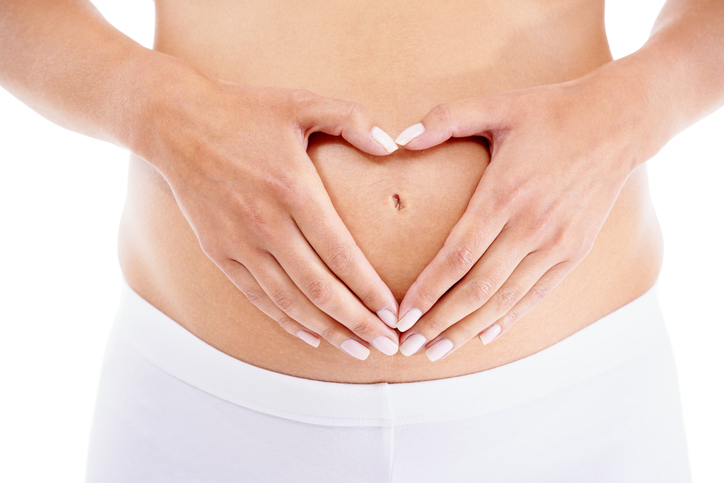
Ordinary movements often reveal what has changed after a second or third pregnancy. Even at her usual weight, a woman may see the midline rise as she gets out of bed, notice softness low on the abdomen or feel less support when she picks up her child. Clothing often gives the first clue, with a waistband rolling, twisting or catching across one area.
Retained weight is only one possible explanation. The muscles, the connective seam between them and the skin have all been under strain, and they do not recover together. Before deciding what might help, it is worth finding out whether the change comes mainly from the abdominal wall, the skin or both.
What repeated pregnancies do to the abdominal wall
Rather than forming one solid muscle, the rectus abdominis runs as two long strips down the front of the abdomen. The linea alba holds the centre between them. As the uterus grows, that central tissue widens, giving the abdominal wall the extra room it needs during pregnancy.
In the months after birth, some of that width may reduce. A later pregnancy stretches the same tissue again, sometimes before the midline has regained much tension. Afterwards, the centre may stay soft, push outward during movement or feel less controlled when lifting.
When strength returns but loose skin or a persistent gap remains, an expert tummy tuck surgeon can assess whether a tummy tuck is suitable for repairing abdominal wall separation, removing excess skin or addressing both concerns. Physiotherapy can rebuild strength and control, while surgery, where appropriate, may address structural changes that exercise cannot alter. That difference affects which treatment options are relevant.
Where abdominal separation becomes noticeable
The mirror is not always where abdominal separation first becomes obvious. Getting out of bed, coughing or lifting a child may produce a ridge through the centre. In other cases, a waistband stops lying flat or the navel shows more clearly under fitted clothes.
The width of the gap does not show, on its own, how well the abdominal wall functions. Tissue tension, symptoms and control during movement matter as well.
A home finger check offers only a rough indication. A GP or women’s health physiotherapist can assess the midline during movement and decide whether guided rehabilitation is appropriate.
Why recovery differs after several pregnancies
Birth count alone does not explain how the abdomen recovers. Two women with the same number of pregnancies can be left with very different changes. The abdominal wall also carries its own history into each pregnancy. Previous surgery can affect how the tissues move, while some connective tissue regains tension more readily than others. The amount of stretch differs each time. NHS guidance on abdominal muscle separation during pregnancy explains that the linea alba lengthens and thins as the abdomen expands. Twins or a larger baby can increase the load across the midline, but neither decides the outcome on its own.
When pregnancies are close together, there may be less time for structured rehabilitation between births. Feeding, broken sleep, lifting a baby and caring for older children also leave little time or energy for regular rehabilitation.
Loose skin may remain alongside muscle separation. Exercise can strengthen the area beneath it, but it cannot remove tissue that no longer retracts. A discussion about a tummy lift should begin with an examination of the abdomen, not with the assumption that one procedure will correct every change left by pregnancy.
Where physiotherapy fits into recovery
Persistent separation can be assessed by a GP or women’s health physiotherapist. Early work tends to centre on breathing, pelvic floor coordination and deep stomach muscle exercises, rather than repeated crunches or demanding core sessions.
A women’s health physiotherapist can watch the midline during normal movement and adapt the programme. Sessions may begin with getting out of bed, lifting without holding the breath and rebuilding control before resistance is added.
Closing the gap is not the only sign of progress. Feeling steadier while walking, exercising or lifting a child may matter more in daily life than a small change in width. Even after months of regular rehabilitation, a visible bulge or loose skin can remain.
When surgery becomes part of the decision
Surgery is not the first answer for every case of diastasis recti. It may become relevant after rehabilitation, once weight is stable and the remaining concern involves structural separation, excess skin or both.
A UK tummy tuck consultation looks at where the loose skin extends and whether repair of the abdominal wall is appropriate. A mini procedure treats a smaller area below the navel. A full or extended tummy tuck reaches farther when loose tissue affects more of the abdomen or continues towards the sides.
Before booking a tummy tuck in London, photographs should not carry the whole decision. NHS advice on checking a surgeon’s qualifications directs patients towards training, relevant experience, professional registration and the care available after surgery. It is also worth asking where the operation will take place, who will provide the anaesthetic and how follow-up is handled once the patient has gone home.
Why timing matters after the last pregnancy
Another pregnancy can stretch the abdominal wall and skin again. Surgery is therefore usually discussed once family plans are complete and the body has had time to settle after childbirth.
Before a date is agreed, the surgeon will usually want to know that weight has stopped shifting. Further loss can leave new looseness, while later gain may stretch the abdomen again. Smoking is another part of the pre-operative discussion. NHS advice on stopping smoking before surgery explains that nicotine reduces blood flow to the wound and leaves healing tissue with less oxygen.
Recovery needs practical planning. Post-operative lifting restrictions may affect childcare during the early weeks, while tasks such as preparing meals or carrying shopping may also require help. Childcare, transport and time away from work are easier to organise before surgery.
Choosing the next step with clearer expectations
Tummy tucks in the UK are not planned from one standard template, because post-pregnancy changes do not follow one pattern. Some women need more time and physiotherapy. Even after months of rehabilitation, others still notice a lower abdominal fold, a ridge through the midline or both.
An assessment looks at when the problem becomes noticeable, whether the midline bulges under load and how much loose skin remains. That may point towards more rehabilitation, a period of monitoring or a surgical consultation. The decision also needs to work in real life, taking account of health, future pregnancies, support at home and the demands of recovery.