
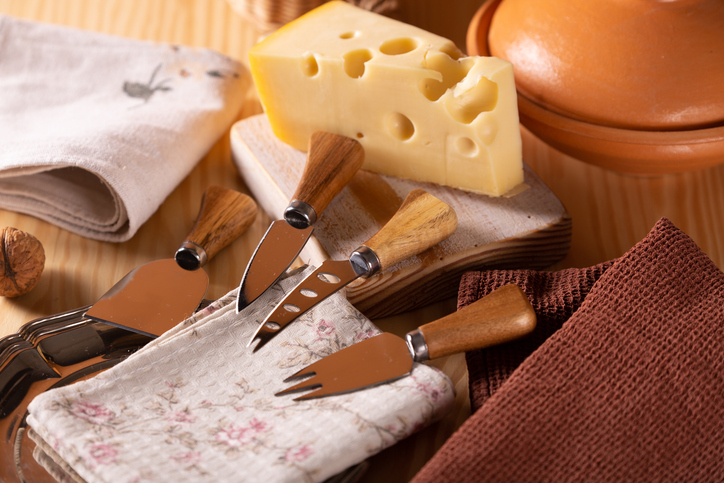
Not all cheeses respond well to the same blade. A wedge of aged Parmesan and a round of ripe brie sit at opposite ends of the texture spectrum, and cutting them requires very different tools. The wrong knife can crush a soft cheese flat, smear it across the board, or send a hard block splintering into uneven shards. Getting the pairing right preserves the character of each variety and makes serving far less frustrating. Here is a practical breakdown of which blades suit soft, semi-firm, hard, and crumbly selections.
Why Blade Shape Matters for Different Textures
Cheese textures vary enormously, from almost liquid interiors to rock-solid aged rinds. A broad, flat blade that works fine on a block of cheddar will drag through brie and leave a sticky mess. On the other end, a thin, flexible knife that handles camembert beautifully will struggle against a dense pecorino.
That is why serious cheese lovers and professionals rely on a dedicated cheese knives set rather than reaching for whatever is in the kitchen drawer. Each blade in a thoughtful collection addresses a particular cutting challenge. Owning the right assortment removes the trial-and-error, so every slice comes out clean and presentable.
Soft and Creamy Cheeses
Best Blade Style: Offset or Skeleton Knife
High-moisture varieties like brie, camembert, and triple-cream rounds are notorious for clinging to flat steel. The paste sticks, smears, and drags, turning neat portions into a messy heap. An offset knife solves this by angling the handle above the cutting surface. That raised grip gives clearance while the thin edge passes through gooey interiors with less resistance.
Skeleton knives take a different approach. Holes punched along the blade face reduce the contact area, so sticky cheese releases after each cut instead of hitching a ride on the steel. For ultra-soft, almost spreadable types, a compact spatula-style tool works even better. It scoops and distributes portions without tearing the delicate rind.
Semi-Soft Cheeses
Best Blade Style: Wire Cutter or Cheese Plane
Gouda, fontina, and Havarti occupy the middle ground. They hold their shape under light pressure, yet compress and deform if forced through a heavy blade. A wire cutter handles these varieties cleanly. The thin wire meets almost no resistance, producing even slices that hold together on a platter or sandwich.
A cheese plane is another strong option here. Running it across the surface shaves thin, slightly curled ribbons with consistent thickness. Those thinner slices also melt faster on warm bread or in baked dishes, which makes the plane a useful prep tool beyond the cheeseboard.
Hard and Aged Cheeses
Best Blade Style: Flat Cleaver or Narrow-Blade Knife
Parmesan, aged Gouda, and Pecorino Romano develop dense, crystallized interiors during months of maturation. Standard kitchen knives tend to produce jagged, uneven breaks rather than clean cuts through these compact blocks. A flat cheese knife distributes force over a wider area, giving more control and a straighter edge in each portion.
A narrow, rigid blade also performs well with this category. Its reduced width focuses pressure along a finer cutting line, allowing precise cuts without cracking the surrounding area. For especially large wheels, scoring a shallow guideline first, then pressing the blade downward along that groove, delivers the neatest result.
Crumbly Cheeses
Best Blade Style: Pronged Knife or Chisel
Stilton, Roquefort, and feta are fractured rather than sliced. They lack the internal moisture that binds softer varieties together, so conventional blades just crush them into uneven pieces. A pronged knife (sometimes called a fork-tipped blade) cuts through the body and then lifts each portion without extra handling or breakage.
For particularly dry or heavily aged blue varieties, a chisel is the better pick. Pressing a chisel into the block along its natural fault lines splits it into rustic, characterful chunks. This method works with the crumbly structure instead of fighting against it.
Quick Pairing Reference
Once the logic clicks, matching cheese to blade becomes intuitive. Soft types pair with offset or skeleton blades. Semi-soft selections respond best to wire cutters or planes. Hard-aged varieties call for cleavers or narrow, rigid blades. Crumbly styles need pronged knives or chisels. Keeping this simple framework in mind takes the guesswork out of any tasting board setup.
Conclusion
Choosing the right blade for each cheese category protects texture, improves portion control, and lifts the entire tasting experience. One mismatched knife can flatten a delicate triple cream or shatter a carefully aged wedge. Building even a small collection that covers soft, semi-firm, hard, and crumbly varieties ensures reliable results across any spread. With the proper tools on hand, assembling a polished cheese board stops being a source of stress and starts being one of the more satisfying parts of hosting.