
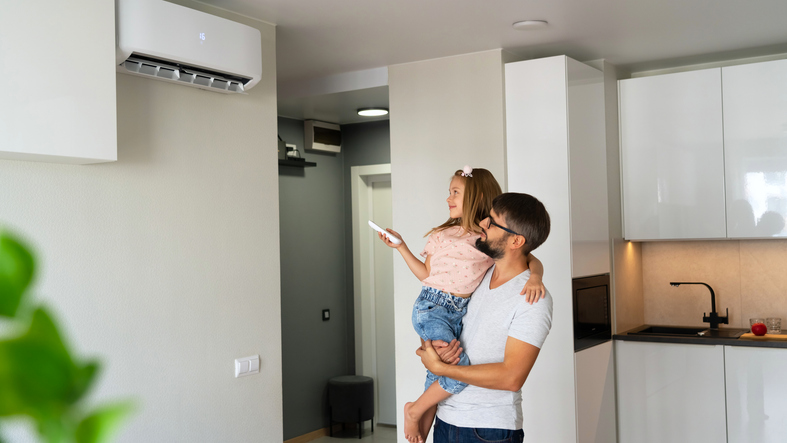
Most homes and small businesses condition every room in the building, whether anyone is present or not. That habit is so ingrained it rarely gets examined, yet it accounts for some of the most consistent and avoidable energy waste in both residential and commercial properties. Heating an empty guest room or running air conditioning in a storage space all day adds real, recurring costs to every utility cycle. Addressing this does not require replacing an entire system. The right equipment makes it entirely possible to condition only the spaces that genuinely need it, precisely when they need it.
Why Central Systems Work Against You Here
Central HVAC systems are designed to assume that an entire building requires conditioning at roughly the same time. That logic holds in certain settings, but it creates persistent waste in homes or offices where room occupancy shifts considerably throughout the day. Closing vents in unused rooms appears to be a reasonable fix, but it raises static pressure inside the duct network and forces the equipment to strain harder than it should.
Households and small offices facing this inefficiency are increasingly choosing a 2-zone mini-split system as a practical, well-matched solution. A single outdoor unit connects to two independent indoor air handlers, each one serving a separate area with its own thermostat and operating schedule. That configuration allows one zone to run at full output while the other sits idle, without adding any load to the shared components connecting them.
What Zone Control Actually Means in Practice
Zone control means each area of a building operates on its own temperature settings, completely independent of every other space. Two occupants with different comfort preferences can use separate rooms simultaneously without any conflict.
More importantly for energy performance, an unoccupied zone draws no conditioning energy while the rest of the system runs normally. That independence is the defining advantage over central systems, which deliver conditioned air to all areas regardless of whether anyone is there to benefit from it.
The Real Difference in Monthly Bills
A property where two independent zones replace a central system for primary living or working areas can produce measurable reductions in monthly energy costs. The precise figure depends on square footage, local climate, and daily usage patterns, but conditioning half the building for half the active day results in proportionally lower consumption in nearly every case.
Scheduling as a Complement to Zone Control
Individual thermostats in each zone allow temperature programs to align directly with real occupancy patterns. A home office zone can begin cooling 30 minutes before the workday starts and return to standby once the evening begins.
Guest rooms, formal dining spaces, and seasonal areas can remain in standby for weeks without affecting comfort in the primary zones. That level of targeted scheduling is simply not achievable with a shared central system governed by a single thermostat.
Installation Without Ductwork
Mini split systems require no ductwork, which removes one of the most significant barriers to upgrading climate control in existing buildings. Installation involves mounting indoor air handlers on interior walls, threading a refrigerant line through a small exterior wall penetration, and connecting everything to the outdoor unit.
Most two-zone installations are completed within a single day by a qualified technician. There is no need to open ceilings, cut into wall cavities, or manage extended contractor access across multiple trades.
Suitable Applications for Two-Zone Systems
Two-zone setups work particularly well in open-plan homes where a main living area and a primary bedroom represent the two most consistently used spaces. Small offices with a reception area and a private workspace are another natural fit. Finished basements, home additions, and converted garages also benefit from dedicated zone coverage without the expense of extending an existing duct system.
Sizing Considerations Before Installation
Each indoor air handler needs to be sized correctly for the space it serves. Oversized equipment cycles too frequently and manages humidity poorly, while undersized units run without interruption and still fall short of target temperatures.
A qualified installer can determine the right capacity for each zone based on room dimensions, insulation quality, and window coverage. Completing that assessment before any purchase prevents common sizing errors that compromise both comfort and long-term efficiency.
Conclusion
Conditioning empty rooms is an easy pattern to fall into and a straightforward one to correct once the right equipment is in place. Zone-based systems give homeowners and small business operators precise, reliable control over which spaces receive heating or cooling at any given time.
The outcome is a more comfortable building, a more predictable energy bill, and a system that responds to actual occupancy rather than running on assumptions. For properties where two zones serve the primary living or working areas, the efficiency gains tend to be both immediate and durable over time.